

January-February 2026
Winter is officially upon us! That means that many have their cars tucked away for the winter. But, it also means many are in the process of getting them ready for spring touring season… and more. In our Model A world there is always something to do. I always have an unending supply of work and things to do in my Model A world. Working on them, travels for parts, a drive now and then, and adventures to see my Model A friends scattered about as time permits. My wife Gina calls it the life of Larry. Yes, always an adventure!
Adding to your “To Do “ list…. Check out the NEW MARC Website!
It has been some time in the coming, and word has it they are still working on it and making tweaks. Like our cars, a work in progress. Check it out, keep up to date on events, cars for sale, Tech stuff is being loaded and will be expanded on. A link to my e-mail is on there.
Last issue in the November December Model A News we had some great Tech contributors. A hearty Thank you to these gentlemen. It is contributions like this that keep our hobby and great Model A News magazine full of great content. Keep them coming!
Special thanks to:
Mark Maron – for his fabulous article on the Model A Gas Gauge
Neil Kaminar – for his great article on front brake rollers and Wedge information & adjustments
Nelson Chegezy – on his wonderful informative article on Bolts, Nuts, & Washers.
There is something to learn in each issue!
I want to also highlight the special youth folks who were the Mayra recipients. On of them, Broc Best is in our own Missouri Valley Region. I’ve helped Broc with his front end and brakes… a fine young man with “A” great future ahead and a great appreciation for his Model A.
I also had the pleasure of meeting Matteo Riordan at Model A Days when he and Paul Shinn were together. A young man with some great talent for sharing the Model A world to us all via the internet!
I recently took a ride in my “A” Friend Mike Shreyer’s ’29 Tudor. It was a cold day but as I entered his Tudor it was toasty warm. He had a Manifold heater… with a twist! This wasn’t just an ordinary manifold heater….. Turns out it was the “enhanced” version made years ago from his Dad when they resided in Minnesota. I have to admit it gave me a new appreciation for heat in a Model A.
Sharing Mikes modified manifold air collector in the photo below. I’m sure its easy enough to duplicate… and I might ad makes quite a bit of difference. 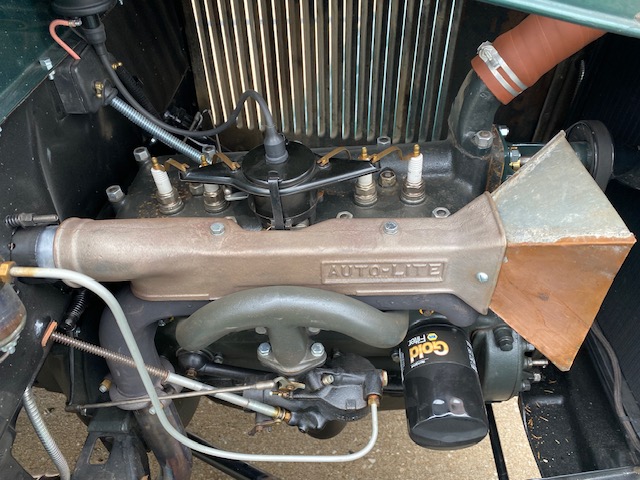
Now on to a few questions!
Question: My driver and passenger door windows creep down about 1-2 inches while driving my 28 Tudor. Any thoughts?
Marvin M.
Answer: Marvin, it sounds like your regulators are worn out. Over time and use the springs get weak and don’t hold well. The new Tudor regulators are excellent. I would just buy new ones and install them. Make sure you grease up the arm and track so they slide easy together.
Question: I would like to know the depth and bevel of the lug nut holes on a Model A wheel. Can they be welded and reground?
Jack G.
Answer : After many years many Model A wheels have ran loose which enlarges the holes and have also been overtightened.. which also damages them. My suggestion would be to carefully inspect the entire wheel for cracks and issues to determine the viability of using the wheel. If you take a good lug nut and hold it into the bevel of the std hole, the lug nut should NOT protrude. If it does it will bottom out onto the hub before the wheel gets tight. This is more common than you might think. Which is why there are some wheel washers available. Important: The only ones to use if you so choose and need are the stainless steel ones. The plain steel ones will split and then its bad news. You also have to be sure to check these frequently because they tend to loosen up. My suggestion when shopping for wheels is to carry a good lug nut in your pocket and do the test as I suggested above. Also, if the holes are ovaled they are “levarites”. That’s French for “Leave R right there” in other words don’t buy, don’t use.
Use good only good solid wheels that aren’t rust damaged on the rim edges (common on 28/29’s), don’t have a lot of run out (wobble), good lug holes, and splits or cracks. A few bent spokes here and there can be corrected with careful persuasion of a few tools to straighten. On the long spokes I like using a 6 inch steel rule to check 3 sides for straightness. 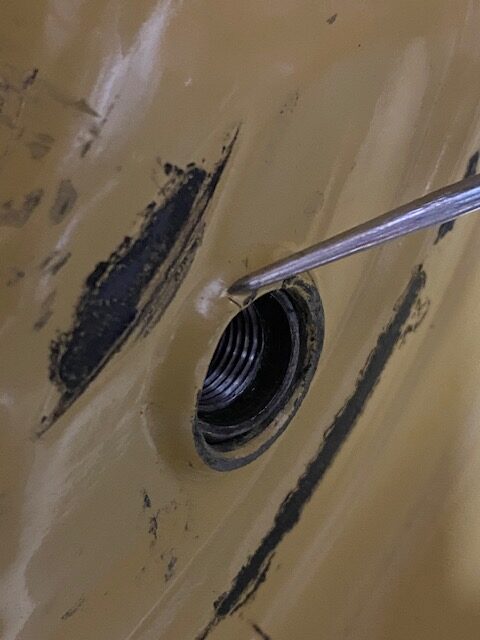
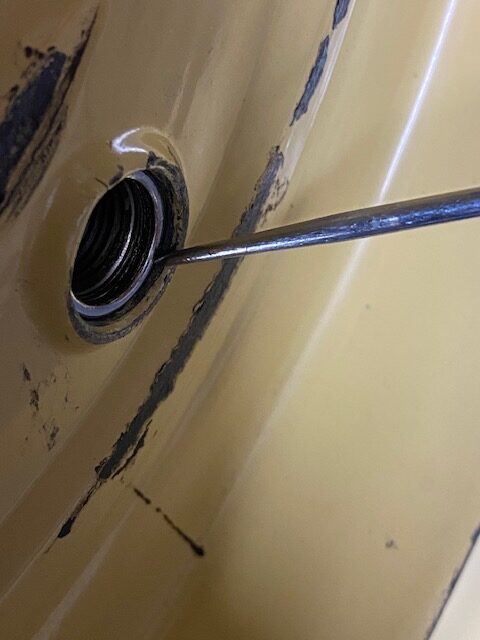
Question: I seem to be having intermittent fuel flow is sometimes good and other times not. My tank looks generally clean any suggestions?
Answer: I would confirm your tank as best you can. One of the scopes to inspect the tank left and right and around your fuel shutoff port checking for sediment and debris. Climb up with a penlight as best you can to confirm how it looks. There are several other possibilities. Ensure your gas cap is venting properly. The new caps ( even the good ones) don’t vent well. I would suggest enlarging the hole in the cap, which is visible when off. Enlarge the vent hole, Use a 1/8 drill bit, careful not to go too deep through the cap. It’s good to go through the gasket a bit because that helps in venting. Usually some of the symptoms I’ve seen with this is that when the tank is full, the pressure of the full tank and less tank air equals better fuel flow. As the tank level decreases the less pressure of tank fuel volume and more air space, especially when warmer can cause a problem if the cap is not vented adequately. You may here a hiss when the cap is loosened, indicating a vacuum release.
I like good original caps with a good new leather gasket if possible, but recognize the scarcity vs availability of the reproductions. Just know repro parts sometimes come with built in problems that need some massaging to make them work and useable.
Question: I have an axle that has a slight bend at the axle threads. Is it ok to use? Is it safe to heat and bend back?
Clark S.
Answer: You’ve recognized thankfully that you have damage to your axle. Know if the axle breaks that the wheel will come off… and the outcome in simple terms is uncertain… and will be unsafe and potentially catastrophic . I’ve probably already answered your question but it is imperative that you have axles that are undamaged and of good integrity for the reasons above. I have experience axle breakage before inside the housing, which was undetectable. Fortunately, I detected a wobbly wheel in a parking lot and discovered it. Yes, I was out of town on tour. I secured a replacement axle and resumed my travels. Realize that if it got bumped it is stressed and the metallurgy and integrity of that axle are uncertain. I know it’s not worth your life. If it means limping home, OK…. With care. Anything more than that it needs to be replaced before any future use. Once out, inspect the other axle and secure good replacements. It doesn’t hurt to magnaflux them either looking for issues around the keyway that gets stressed. The 3 things to look for are; 1)Good tight keyway /key fit, 2) good threads with a good new axle nut, 3) good gear end. Don’t get super excited about a little wear where the inner axle seal goes.
Understand that we are approaching the 100-year mark and the use and abuse and metallurgy all come into play on our cars, rear axles certainly high on my list for safety.
I don’t believe any new ones are available. By aware there were some poor reproductions at one point that had a two piece with a press on gear on the end. I have no personal experience with them.
As to my knowledge the better axle is now longer being made, which puts us back to the originals.
Know that rebuilding a rear end is like rebuilding an engine, a process which begins with a thorough inspection, and in restoration, rebuilding, replacement, machining if necessary, and tolerances and preloads that need to be set.
Question: I don’t seem to have any clutch pedal free play but my clutch generally seems to work OK. Do I have an issue? Advice appreciated.
Roger T.
Answer: The correct clearance or free play for the clutch is about ¾-1 inch free play from the rest of the pedal to the point of pressure and disengagement of the clutch. If you don’t have any free play you are potentially keeping your Throw-out bearing moving and engaged all the time which will wear it out quickly. So your perceptiveness in this is good and adjustment correction necessary. The “Model A Instruction Book” says 1”. As the clutch wears this clearance grows less. The adjustment is made by adjusting the yoke fork ( clevis) on the end of the clutch pedal link. Turning the rod in decreases the clutch pedal free play, turning the rod out increases the play. Adjust so you have the ¾-1 inch free play . It sometimes helps to have someone hold the clutch pedal up so you can push the arm up and engage the pin.. A medium pipe wrench or stilson (same as pipe) will help if needed. Check and recheck your adjustment. Remove the Bell housing inspection cover and check the finger movement and lube the clutch release hub. Ensure the bearing is OK.
Hopefully all will be well.. contact me if you have additional questions.
Question: Where is the proper place to run my spark lever. I hear all kinds of answers from other Model A owners from all the way down to about 9:00 ish. Where should it be?
Answer: That is an excellent question and one that is one of the most important operational questions. Also, one that is answered in every owners Manual! I know there’s a lot of opinions…. So I went to the Owners Manual myself for the following, and will give you my opinion at the end.
From the Model “A” Owners Manual, Page 10, 1931
“The Spark Control”
“The Average driving the spark lever should be carried about half way down the quadrant. Only for high speeds should the spark lever be advanced all the way down the quadrant. When the engine is under a heavy load as in climbing steep hills, driving through heavy sand, etc., the spark lever retarded sufficiently to prevent knocking”.
My comments as promised….
First, the car should be properly timed with points set ( I set to .020) and timing set so that the points just start to open accounting for the backlash in the rotation of the distributor shaft and cam. A good check is to turn the ignition switch on with coil wire held to a head stud, (spark lever up from the start), and a spark should occur when the distributor is rotated counter clockwise causing the points to open and the field coil collapses thus firing the high tension build up of the coil through the coil wire to the distributor. If timed properly the coil should be seen firing when you toggle the backlash.
Many times owners over advance the timing, which can cause engine knock, in extreme cases a rattle… and ultimately do harm to the rods and engine overall that shouldn’t occur. Good Model A driving includes being in tune to your car… listen to it, experiment with the spark and GAV Fuel mixture (choke GAV rod)
I run mine around 9:00 ish, with a bit more for freeway driving to full advance if needed. Advancing will give you more power… but there is a danger of running that all the time and over advancing. In my opinion after driving Model “A’s in all elevations from Pikes Peak to flatlands, and Blue Ridge Pkway and more, I generally do Not retard my spark going up hills. But, I do listen to the engine and give it what it needs and feels good. More timing if needed on the lever, and more mixture at the GAV if necessary.
Ford gave us an adjustable variable timing for variable conditions. Use it, but use it wisely. Those that run all the way down many times over advanced will generally have engines that don’t last as long as one that has been more carefully and skillfully driven over time.
Long answer I know but an important one.
Question: Where do I get a Model A Dash light. Seems as though all the suppliers are out and have been for some time. Any suggestions? Larry Y.
Answer: The Model A Dash lights haven’t been reproduced for some time, sadly. I know some of the key suppliers who handle original parts do not have them either… as probably whenever they show up they get snatched up. I believe Dan Bixby at Strictly A’s has originals now and then. I would contact him to see. Dan has lots of small original parts that are a good resource. Lots of other members of local clubs, Swap meets, Ebay, Vintage Ford Forum (VFF) Fordbarn, and putting a wanted ad on the new Marc website, at modelarestorersclub.org are ways of working to find one. I stumbled across some this last year for my projects. The brackets on the 30/31 are different between open and closed just so you understand that. Brackets can be made to work. If you find any one of them I’d snatch it up. They are out there. Hopefully the suppliers will get someone to produce one down the road.
Question: Is there anyone who makes a good Cowl lacing. The one I ordered from one of the suppliers is round black sticky and it doesn’t look nor fit right. I can’t open my hood now! Most of the others I see are brown and flat. Any suggestions? Jim R
Answer: I know that some of the supplies and suppliers of the parts we’ve been use to have changed for one reason or another. I have dealt with that particular cowl lacing and they have an asphalt coating to them, which of course sticks to the hood. The originals did not have the “asphalt” coating. Not only are they the wrong shape (can be formed), but the material is wrong. It can be frustrating but I would contact the key suppliers to our Model A hobby first, and see what you come up with. I know Restoration Specialties in Pennsylvania has a variety of cowl lacing. Some I have used before with good results. They can be reached at 814-467-9842. They serve the Restoration community at large and they are on my stop and visit folks at Hershey every year and are very accommodating. We Model A restorers are spoiled to order from our favorite supplier on items. Imagine restoring a 1930 Studebaker (which I have done) and trying to find stuff for them in the process.
Be patient and diligent… it will come.
Till next time….
Larry Shepard